Indigenous nations, who have centuries of experience in diplomatic protocols, are becoming increasingly recognized as diplomatic actors rather than as ethnic minorities of their encapsulating states. One implicit recognition of this fact is the way in which Canada began its 2022 Indo-Pacific Strategy with the observation that the region accounts for 67% of the world’s Indigenous peoples. Under the strategic objective of “investing in and connecting people,” Canada’s strategy promises to pursue the path of reconciliation through enhanced Indigenous exchanges with regional partners such as Australia, New Zealand, and Taiwan; implement the Indigenous Peoples Economic and Trade Cooperation Arrangement (IPETCA); and promote implementation of the UN Declaration of the Rights of Indigenous Peoples (UNDRIP).
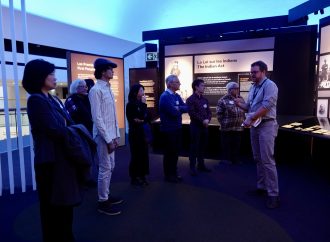
Connecting Indigenous nations and state actors in new ways requires a reappraisal of the way in which those relations were conducted in the past; and reflection on how to make reconciliation possible. One of the main interfaces between states and Indigenous nations, across oceans as well as within more local contexts, has been the museum. Museums, as state institutions, often collected items from Indigenous communities without consent and in disrespectful ways. Yet, they are also arenas where peoples can learn about one another, which inspired anthropologist James Clifford to frame them as contact zones between peoples. With the goal of promoting reconciliation through museum practices in the Indo-Pacific, professors Scott Simon (Faculty of Social Sciences) and Robert-Falcon Ouellette (Faculty of Education) organized an international workshop titled “Indigenous Peoples and the Museum in the Indo-Pacific” on November 3, 2025, at CIPS.
With separate funding envelopes from Global Affairs Canada (GAC) and the Ministry of Education (MOE, Taiwan), the project brought together Indigenous people, museum professionals, and university-based scholars to discuss how museums, grappling honestly with their colonial past, can now play a role in both Indigenous reconciliation and Indigenous diplomacy. Their discussions were based on Article 31 of UNDRIP, which affirms that Indigenous peoples have the right to maintain, control, protect and develop their cultural heritage, traditional knowledge and sciences. Canadian museums, following the Call to Action #67 of the Truth and Reconciliation Commission 94 Calls to Action, are working to develop new protocols and partnership agreements for repatriation, collections management, and ongoing relations. Canadian museums include artefacts from Indigenous nations in Canada, but also from Indigenous nations across the Indo-Pacific. Museums in Japan and Taiwan, to name just two leading examples, also house Indigenous artefacts from Canada as well as from Indigenous peoples in their jurisdictions. These collections indeed make museums into contact zones for international relations between states and Indigenous peoples.
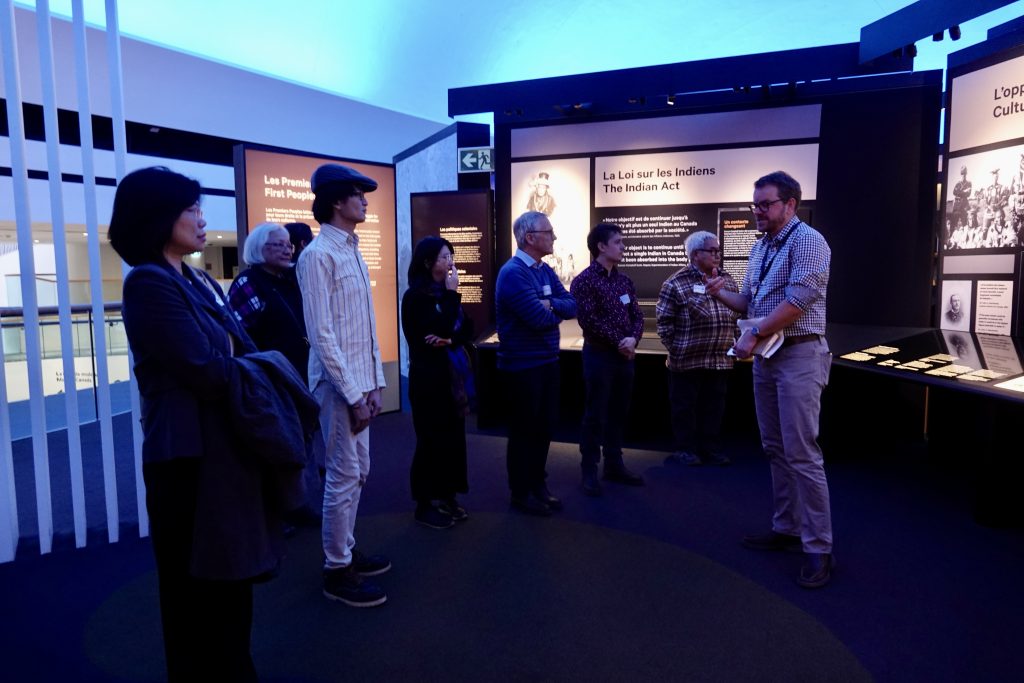
In this first stage of this three-year project, a select group of scholars came to Canada. The invited guests on the GAC project included Futuru Tsai (National Museum of Prehistory, Taiwan), Atsushi Nobayashi (National Museum of Ethnology, Japan), Iwan Pelin (Seediq Nation and Providence University, Taiwan), and Pei-lin Yu (Boise State University, USA). They met with academic visitors coming to the University of Ottawa with the MOE-funded Research Chair in Taiwan Studies, namely Pi-chen Liu (Academia Sinica, Taiwan), and Frédéric Laugrand (UCLouvain, Belgium); as well as the University of Ottawa’s own postdoctoral fellow Antoine Laugrand. For the international visitors from the Indo-Pacific, the visit began in Winnipeg on exchanges with the Canadian Museum for Human Rights, the Saint-Boniface Museum, the Winnipeg Art Gallery, the Manitoba Museum, and the National Indigenous Residential School of Canada.
The CIPS conference began with a keynote address by Gilbert Whiteduck, Knowledge Holder in Common Law and Chief of the Kitigan Zibi Anishinabeg First Nation from 2008 to 2015. Having personally organized the repatriation of human remains from the Canadian Museum of Civilization to Kitigan Zibi in 2005 and a subsequent international conference (which had at least one Taiwanese participant), he reminded the audience that much work remains to be done on reconciliation, repatriation, and relations with museums. His words were followed by opening remarks from Mary Pierre-Wade, Deputy Director of Indo-Pacific Outreach, and Representative Harry Tseng from the Taipei Economic and Cultural Office in Ottawa.
The panelists shared best practices in reconciliation between Indigenous peoples and museums, of which repatriation is only one option. Panel 1 explored how museums collaborate with Indigenous peoples, for example by inviting them to the collections to work on projects such as making replicas of artefacts. By doing so, the Indigenous artisans can learn techniques that had been lost during decades of assimilationist policies. There are also issues of digital sovereignty as collections go online. Iwan Pelin, of the Seediq Nation of Taiwan, shared her experiences co-constructing the exhibit We are Seediq with the Museum of Ethnography in Sweden. The main takeaways are that Indigenous peoples maintain a form of residual sovereignty over many artefacts, and that museums have an obligation to develop respectful protocols about the collection, preservation, display, and sometimes repatriation of the objects. In Panel 2, Liu Pi-chen explored the Indigenous artefacts collected in the Mackay collection at the Royal Ontario Museum. The remaining contributions explored museum collections as part of intergenerational and multispecies entanglements. The objects themselves can serve as diplomats between peoples and across worlds.
This project about international Indigenous reconciliation and museums contributes to the goal in Canada’s Indo-Pacific Strategy to promote people-to-people ties as a part of everyday diplomacy. There is still much work to be done as museums across the region help states and Indigenous nations realize their mutual goals of true reconciliation. Future events will be held in Taiwan and Japan, with the goal of publishing an edited volume about the unfolding relations between Indigenous peoples and museums in the Indo-Pacific. This project will also provide new insights into the nature of International Relations in the region.
Watch the video of the event here.