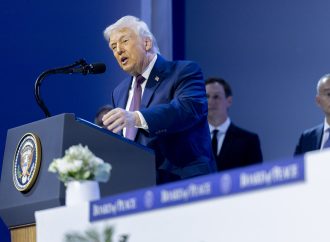
The joint Israeli-US strikes against Iran’s nuclear facilities in June were supposed to end the threat of Iranian proliferation for decades to come. Certainly, President Trump claimed that they had succeeded and that Iran’s most concerning nuclear sites were “Completely and fully obliterated.”
It now appears that this was not true. As many analysts had predicted at the time, it is now widely accepted that Iran clandestinely moved a stockpile of its enriched uranium to secure locations, along with some of the technology needed to pursue the programme. It has also stopped collaboration with international inspectors that had given at least some insight into where the programme was.
In short, the strikes did not stop Iran’s nuclear project. They only delayed it by an unknown period. They also drove it even further underground (in both literal and metaphoric senses), so we know even less today than we did before about where it really stands.
The strikes bought some time, but we don’t really know how much.
They also seem to have forced Iran to pursue even closer collaboration with countries like Russia and China, with large-scale deals reportedly being considered to trade Iranian oil for Chinese ballistic missile components and air defence systems.
Diplomacy aimed at containing Iran’s nuclear programme is stalled. There had been some quiet talks with the US about nuclear issues earlier this year, but these stopped with the bombing and do not appear to have resumed. The deal that was signed in 2015 (the one that Trump withdrew from in his first term) has now expired and the Iranians say they no longer regard themselves as bound by its terms. In response, the other members of the deal have re-instated the sanctions they had in place under the so-called “snap-back” provisions.
To all of this, the Iranians have responded with expressions of defiance.
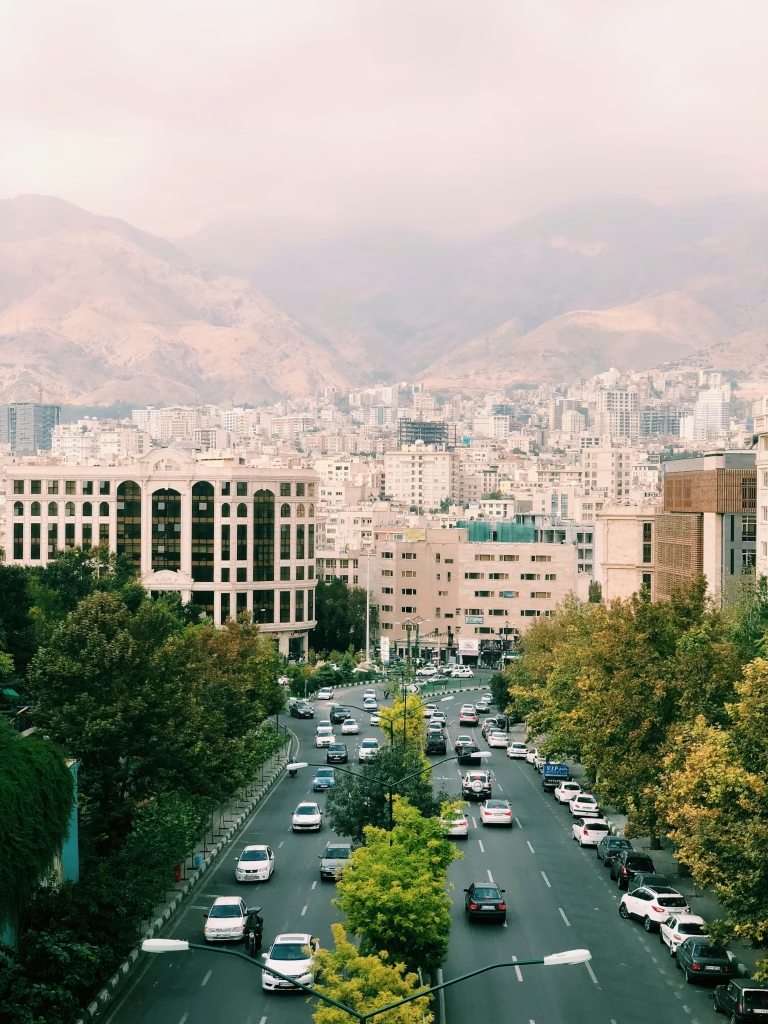
Not that Iran does not have serious problems. Decades of corruption, mismanagement and sanctions have left the economy in tatters. The currency is in freefall and basic goods are either unavailable or increasingly beyond the economic reach of ordinary Iranians. A severe drought, and many years of water mismanagement, have left much of the country parched – there is even talk of the need to evacuate parts of Tehran due to water shortages. The ease with which Israeli and US forces picked apart Iran’s defences to roam unobstructed over the country for 12 days, bombing sites at will, has exposed to the Iranian people how ineffective their government really is, despite decades of aggressive bluster. The political system is even shakier than usual as these crises play out against the backdrop of the likely need to replace the Supreme Leader in the not-too-distant future – a once-in-a-generation political battle that will stress the system and could even tear it apart.
For now, the Iranian leadership has responded to its domestic problems with band aid solutions, such as a significant relaxation of repressive dress codes for women in public. The regime has done this before when facing trouble, and it helps for a time in terms of relieving the pressure of public discontent. But it is no long-term solution in terms of the systemic problems the country faces. People know from past experience that the repression will return when the regime feels it can get away with it. And it is lost on no one that the relaxation of hijab requirements has gone hand-in-hand with a crackdown on political opposition; women may be able to dress less restrictively, for now, but anyone working for real change will be dealt with harshly.
Where is all this leading?
It seems that the main hope of those who launched the strikes is for an uprising against the regime. If only the nuclear programme can be delayed long enough, and the pain of the Iranian people be increased sufficiently, sooner or later something will give and a regime will be put in place more amenable to Western interests. Maybe, but we have no way of knowing if this will actually happen or when. The Iranian regime has proven itself expert at repression. We also have no way of knowing if any successor regime will actually be a friendly one as far as the West is concerned; other orientations are possible. Better the devil you know?
And so come back to the very thing that Netanyahu, Trump and other assorted hawks have long dismissed – diplomacy.
Senior Iranian officials, while promising defiance, have also been signaling that they are open to talking. When you get behind the defiant rhetoric, there is a sense to this and it should be taken seriously. There is, of course, no guarantee that renewed diplomacy would itself lead to a solution to the problem which could be accepted by all. Trust is almost entirely lacking on all sides. Hawks on both sides will regard renewed talks as a trick perpetrated by the other side to buy time for nefarious plots to be incubated and hatched.
But what other choice is there? Hoping for a popular uprising is not a strategy. If the June strikes really did buy some time, surely some of that time could be used to get back to the table.
Canada will have no role in this. Successive Canadian governments have cut us off from Iran, largely to satisfy noisy domestic constituencies who have an axe to grind against the regime there. It is no model of a regime, to be sure, but we have relations with others who have at least as bad a record as Tehran does. Specific constituencies here in Canada, however, have long-since pressured a compliant succession of both Liberal and Conservative governments into abandoning diplomacy with Iran. It is a case study in the dangers of allowing the political threats of diasporas and pressure groups to dictate one’s foreign policy.
Of course, it is not very likely that, were Canada to be present in Iran, we would play the decisive role in bridging the gaps over the nuclear issue. But we could at least help, and we would have a window into the talks that will be going on over one of the crucial issues in the Middle East today.
Instead, we will sit on the sidelines and have no impact whatsoever.