Canada is preparing to release its first National Security Strategy since 2004. Twenty-two years. A strategic eternity. Since then, the world has tipped over—and with it our mental comfort. The international order that protected Canada while asking little in return has fractured. That threat does not come only from Moscow or Beijing. It also comes—and increasingly clearly—from Washington.
This idea may seem shocking because it clashes with decades of Canada–U.S. friendship and a “benevolent” U.S. hegemony. But international politics is not a scrapbook of memories: it is made of power relations, and those relations have changed. The U.S. threat to Canada will outlast the Trump administration for three reasons.
The first reason is ideology. The U.S. government openly supports extremist political forces, promotes leaders aligned with Trumpism, and marginalizes those who diverge from it. Security thus becomes conditional on political alignment with Washington.
Ideology, in turn, informs an imperial approach to resources. The official U.S. rhetoric toward Venezuela and Greenland is unambiguous: certain resources are deemed too strategic to be left to the sovereignty of others. Where consent is not forthcoming, pressure will be applied.
The third reason is geography. In the Western Hemisphere, strategic autonomy is no longer tolerated. It is redefined as deviation—and treated accordingly.
The Carney government in Ottawa knows all this, hence the attempts to diversify the Canadian economy, while developing greater autonomy in defence. But the forthcoming National Security Strategy will have to address a basic strategic dilemma last discussed a century or so ago: vassalization or resistance.
The first option is comfortable—in theory. It means continuing as before: buying American, thinking American, planning our defence in the shadow of the Pentagon. By inviting the U.S. empire in, vassalization allows the preservation of what remains of core Canadians values and institutions. The resistance to the idea of diversifying our trade with China and other overseas markets attests to the strength of this way of thinking.
The second option is demanding in both theory and in practice. It is costly and politically risky. But it is the only option compatible with the very idea of sovereignty.
To resist is to accept a brutal truth: the only language the Trump administration understands is the language of power. Resistance therefore requires substantial investment in our security and defence capabilities as well as in our economic resilience – at the expense of budgetary certainties to which we have grown accustomed since the time of the Korean War.
Resistance, however, cannot be a solitary project. The path forward runs through a partnership of the willing democracies.
The first concrete test will be Greenland. If Canada is serious about sovereignty and international law, it must join the European initiative aimed at offering the government and people of Greenland a kind of pact of security, defence, and economic development—one that is consensual, not imposed. If democratic allies fail to provide a credible alternative, they will leave the field open—including the rest of the Arctic region—to U.S. coercion.
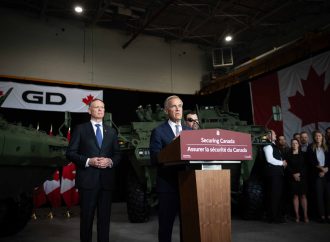
The second test will come from our choices in military procurement. Will we continue to align ourselves with the U.S. military-industrial complex, or will we accept diversifying our partnerships, at the risk of irritating Washington? This choice is deeply political. It will determine whether Canada sees itself as a strategic actor or merely as a loyal customer. The Defence Industrial Strategy, which has yet to be unveiled, will signal the direction chosen by the Carney government, as well as the scale of the resources it is willing to commit to its implementation.
Canada must choose. And it must do so now.
Justin Massie is a professor and head of the Department of Political Science at the Université du Québec à Montréal. Srdjan Vucetic is a professor at the Graduate School of Public and International Affairs, University of Ottawa.
This text was originally published in La Presse on January 19, 2026 / Ce texte a été publié à l’origine dans La Presse le 19 janvier 2026.