Current geopolitics has certainly brought Canada and the European Union closer than ever, a natural development in a decades-old friendship.
This year marks the 50th anniversary of the Delegation of the European Union to Canada. The EU’s diplomatic mission in Ottawa threw open its doors on 19 February 1976, but EU-Canada relations date back to 1959 when the Canada-Euratom Nuclear Cooperation Treaty was signed and the first Canadian Ambassador was accredited to the European Commission.
Over the following decades, the EU and Canada continued to build what has become an exemplary partnership, based on shared democratic values and worldview. Recent progress in security, digital cooperation, energy resilience, and support for Ukraine reflect a partnership with genuine momentum. Now, more than ever, the EU and Canada stand together as stable, trusted allies in a challenging global landscape.
EU-Canada Cooperation in Action
In 2025, Canada and the European Union found themselves navigating a fast-changing international environment marked by geopolitical fragmentation, U.S. tariff pressures, and Russia’s ongoing war against Ukraine. In this context, the EU–Canada relationship stands out as a source of stability and strategic alignment. What began in 1959 as cooperation between like-minded partners has evolved into a multifaceted strategic relationship, rooted in shared values and responsibilities.
2025 Highlight: The EU–Canada Summit
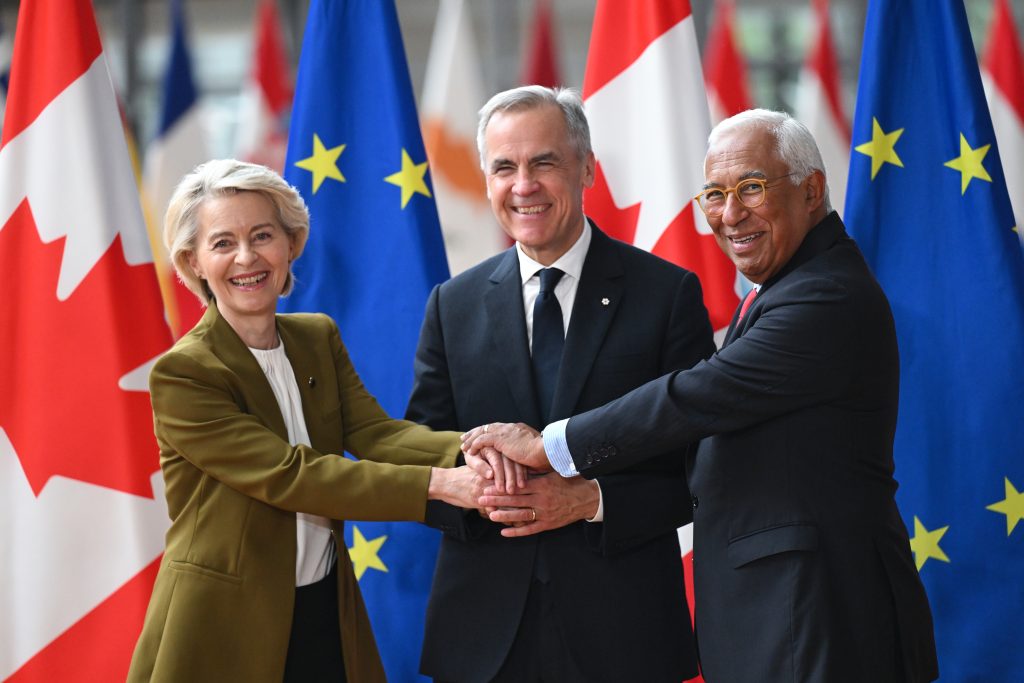
On 23 June 2025, leaders from the European Union and Canada gathered in Brussels for the 20th EU–Canada Summit. This milestone meeting reaffirmed the depth of the bilateral relationship and set out an ambitious agenda covering key areas such as trade, security and energy. Leaders also reiterated their shared commitment to multilateralism, the rules-based international order and continued support for Ukraine.
Together, leaders endorsed the New EU-Canada Strategic Partnership of the Future. It provides a forward-looking framework to deepen cooperation in response to today’s needs and that will evolve to meet future challenges and opportunities. The partnership commits both sides to strengthening trade, transatlantic security, resilience and competitiveness in strategic value chains, digital policy, and to jointly shaping the digital transition and climate action.
A major achievement at the Summit was the signing of the Security and Defence Partnership. It is the most comprehensive security agreement ever concluded between Canada and the European Union. The partnership provides a framework for cooperation on cyber defence, hybrid threats, space security, maritime issues, crisis response and assistance to partners like Ukraine. It also creates new opportunities for collaboration among defence industries on both sides.
During the Summit, the leaders decided to launch a concrete plan of action. In the months that followed, both sides have worked together to put these commitments into practice. A first assessment was conducted during the fourth Joint Ministerial Committee meeting, which was held in Niagara on 11 November and was co-chaired by the Canadian Minister of Foreign Affairs, Anita Anand, and the EU High Representative, Kaja Kallas.
Key Areas of Cooperation for Canada and the EU Today
Trade and economic agreement
Trade is a cornerstone of the EU–Canada partnership. Since its provisional application in 2017, the Comprehensive Economic and Trade Agreement (CETA) has significantly deepened economic ties by eliminating tariffs on 98% of goods, opening public procurement markets and creating new opportunities for businesses of all sizes. CETA supports high standards on labour, environmental protection and sustainable development, while providing a predictable and transparent framework for transatlantic trade and investment. The European Union and Canada are also working towards a Digital Trade Agreement that will complement CETA and support trusted and predictable data flows.
Security and defence cooperation
Work under the Security and Defence Partnership has progressed quickly in recent months. An annual Security and Defence Dialogue has been established, with the first meeting taking place during the November Ministerial Committee. Discussions on a defence industrial cooperation arrangement have now concluded, enabling Canadian companies to participate in the European Union’s Security Action for Europe (SAFE) procurement instrument. SAFE supports joint defence procurement and enhances the resilience of the European and transatlantic defence industrial base. Canada is the first non-EU country to join the programme. Work is also underway on an administrative arrangement with the European Defence Agency to deepen technical cooperation and support capability development.
Digital partnership
On 8 December 2025, the European Union and Canada convened the first meeting of the EU–Canada Digital Partnership Council in Montreal. During this meeting, both partners signed memoranda of understanding (MoUs) covering cooperation on artificial intelligence (AI), and on digital credentials, digital identity wallets and trust services. This new forum will guide collaboration on AI governance, quantum technologies, cybersecurity and digital standards. The goal is to build digital systems that are secure, transparent and centred on public trust.
Energy, critical raw materials and industrial cooperation
Economic resilience remains another important pillar of the partnership. Planning is underway for a new EU–Canada Industrial Policy Dialogue that will support cooperation in strategic sectors, including clean technologies and advanced manufacturing. Both partners are also accelerating the implementation of the Strategic Partnership on Raw Materials, with particular attention to rare earths. Further collaboration is ongoing to strengthen energy supply chains, including natural gas and clean-tech components.
Continued support for Ukraine
The European Union and Canada remain closely aligned in their commitment to Ukraine. Both partners continue to coordinate sanctions, military assistance and financial support, as well as efforts to ensure accountability for violations of international law. This cooperation is one of the strongest demonstrations of the strategic value of the partnership.
A Partnership with Momentum
The June summit marked more than a symbolic milestone. It opened a new chapter in EU–Canada cooperation that delivers clear results.
As the European Union celebrates the 50th anniversary of its diplomatic mission in Canada in 2026, this momentum carries particular significance. The EU-Canada friendship is long-standing and rooted in our shared values, and it has evolved into a strategic alliance. The EU and Canada are working together to build a more prosperous, secure and sustainable future.
This blog is related to a presentation given by Charlotte Bué, Head of Division for the United States and Canada, European External Action Service, on November 12, 2025.
About the Author:
Geneviève Tuts is the Ambassador of the European Union to Canada. She began her tenure at the helm of the Delegation of the European Union to Canada in September 2024. She has extensive experience gained in several EU institutions, the Belgian Ministry of Foreign Affairs, and the legal profession. She served as the Head of Cabinet for European Commissioner for Justice between December 2019 and August 2024. The portfolio included Justice, Rule of law, data protection, and consumer law.