By Yiagadeesen Samy and Stephen Baranyi
On 22-23 September, the UN Summit of the Future will seek to enhance global cooperation and accelerate progress towards the Sustainable Development Goals (SDGs). Adopted by all UN member states in 2015 as part of Agenda 2030, these SDGs or Global Goals have been seriously off track for some time.
This setback is partly due to the ongoing polycrisis: starting with the Covid-19 pandemic and its economic and social impacts, followed by wars between Russia/Ukraine and in the Middle East, the climate crisis, challenges to democracy and the rise of authoritarianism, and an increase in the cost of living. It is also the result of underinvesting in the Global Goals, as made clear in the UN’s SDG 2023 Report.
Beyond the UN Summit in September, July 2025 will be crucial since that is when the fourth International Conference on Financing for Development (FfD) will be held in Madrid. That conference will offer an opportunity to renew our investment in economic, environmental and social priorities for a more inclusive and sustainable world.
Canada has an opportunity to reaffirm its commitment by making firm pledges to invest more in development — specifically peace, justice and strong institutions codified in SDG16. Ottawa is investing about 10% of its development assistance in those priorities, based on its 2017 Feminist International Assistance Policy. Yet preliminary numbers for 2023 indicate that Canada’s foreign aid budget of about US$ 8 billion, representing 0.38% of our national income, remains below the average country effort of 0.43% by all rich donor countries. Moreover, Canada’s aid figures are boosted by our massive aid to Ukraine and by counting in-Canada refugee resettlement costs.
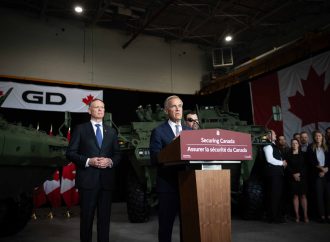
Unlike our recent commitment to increase defence spending, there is no clear timetable for our spending on international development. We can and should do better.
First, a change in narrative about development assistance or foreign aid is long overdue in this country. The federal government needs to make a clearer case domestically that spending on international development is not just about our own self-interest nor a moral imperative. Development spending, including on global public goods like peace and justice, is an investment that yields benefits for everyone in the long run.
Second, like the g7+ group of fragile countries, researchers have used the term SDG16+ to make the point that SDG16 is a strategic lever to enable the implementation of the other SDGs, and especially in fragile and conflict-affected states/situations (FCAS). Simply put, the achievement of the development goals is impossible without peace, justice and inclusive institutions. If we are serious about eradicating absolute poverty, we need to invest in FCAS. Failing to do so is more costly for everyone when these states fail, as we have seen from Afghanistan to Mali and Haiti.
Investing in development also implies a bigger role for public finance. At the third FfD conference held in Addis Ababa in 2015, the focus shifted from leveraging public money to generate private finance, and the need for countries in the South to raise more revenue domestically. The World Bank, with the support of other international financial institutions coined the phrase “from billions to trillions” to address the SDGs financing gap between available development assistance versus the potential of private money.
Unlike our recent commitment to increase defence spending, there is no clear timetable for our spending on international development. We can and should do better.
In fact, using public finance to leverage private capital has proven to be more difficult. Several developing countries are already making a lot of effort to mobilize domestic resources. On the other hand, it took several years for the UN to pass a resolution on international tax cooperation that will allow tax rules to be decided at the UN instead of the OECD group of rich countries. There was strong opposition from the EU, the UK and the US along the way, and Canada was unfortunately among the group of (mostly rich) countries that voted against the resolution.
More public finance is needed for the Global Goals, including resources for peace, justice and inclusion, as well as climate adaptation. The assumption that private finance, motivated by profits, was a perfect substitute for public finance was naïve to begin with.
We also urge Canada to support the 2024 Rome Civil Society Declaration on SDG16+. The Declaration recommends the establishment of a Global SDG16+ Fund, more support for civil society organizations and increased funding for conflict prevention, peacebuilding, and post-conflict reconstruction efforts.
Canada has an opportunity to demonstrate its commitment, both politically and financially, on these issues at the UN Summit of the Future and the next FfD conference.