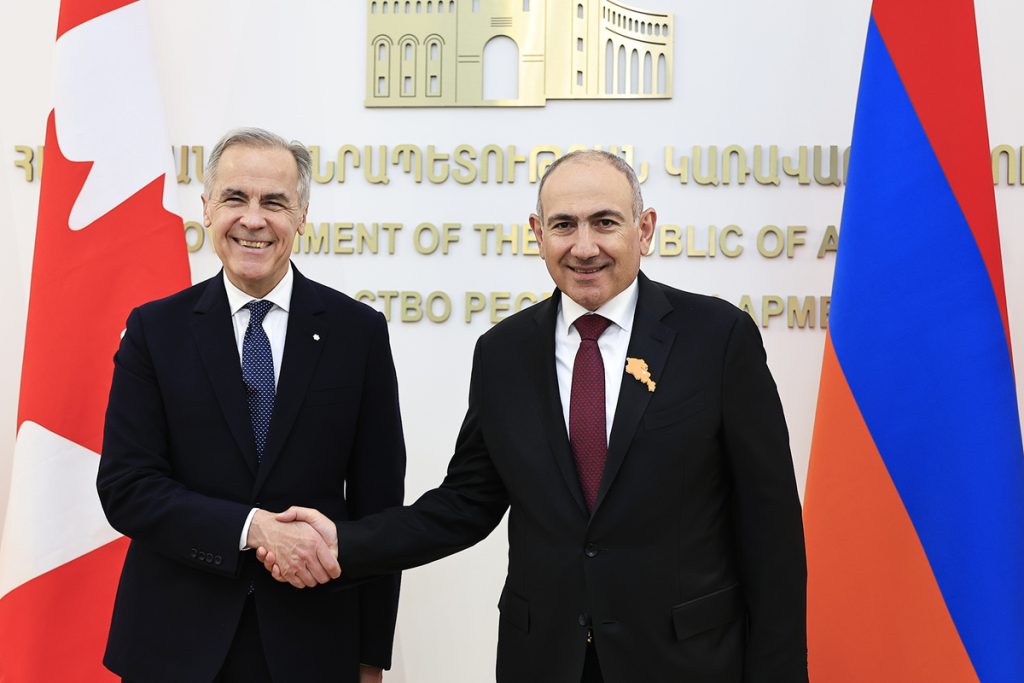
In May 2026, Canadian Prime Minister Mark Carney travelled to Yerevan to attend the 8th European Political Community Summit. This visit constituted the first visit by a sitting Canadian prime minister to Armenia in nearly a decade. The Canadian delegation’s engagement focused primarily on issues of collective security and transatlantic defence cooperation. In parallel, Canada announced a new CAD 270 million assistance package in support of Ukraine, underscoring its continued commitment to European security and allied defence efforts.
On the margins of the European Political Community Summit, Prime Minister Carney met with his Armenian counterpart Nikol Pashinyan to discuss bilateral relationships between the two countries. While celebrating Canada’s important Armenian diaspora, the high-level bilateral meeting fell short at engaging with key political and geopolitical issues for Armenia and the South Caucasus in general.
In recent years, Canada has emerged as an increasingly significant partner for Armenia. In 2023, Canada opened its first embassy in the South Caucasus in Yerevan, signaling a strengthened commitment to bilateral engagement. Ottawa has also expressed explicit support for Armenia’s democratization trajectory following the 2018 Velvet Revolution, which brought Prime Minister Nikol Pashinyan to power.
In this context, Canada has sought to position itself as a supporter of democratic governance and institutional reform in Armenia. In 2022, Stéphane Dion, then Special Envoy of the Prime Minister of Canada to the European Union, Europe, and Armenia, published a comprehensive report outlining Canada’s strategic approach to supporting Armenia’s emerging and fragile democracy. The report emphasized the promotion of human rights, political reforms aimed at combating corruption, and long-term sustainable development as central pillars of Canada’s engagement.
Although Prime Minister Carney stated at the European Political Community Summit that the international liberal order could be “rebuilt out of Europe” in line with his now famous Davos speech in January 2026, his visit to Yerevan appeared driven more by economic and security-related imperatives than by a willingness to take a clear and principled stance on human rights and international law.
In contrast to the Trudeau administration’s sustained engagement with Armenia and its democratic development, Prime Minister Carney’s visit represented a missed opportunity to reaffirm Canada’s continued support for democratic governance in the region. This strategic omission was particularly notable given Armenia’s upcoming parliamentary elections in June 2026 and, more broadly, the need to underscore Canada’s commitment to human rights and respect for international law in the South Caucasus.
Furthermore, against the backdrop of the August 2025 Washington Accords between Armenia and Azerbaijan and the launch of the Trump Route for Peace and Prosperity, Canada missed an opportunity to provide additional diplomatic support to Armenia during the final stages of the peace process. While the broad framework for an agreement has been established by the two parties with the backing of the Trump administration, several key issues remain unresolved, reflecting the asymmetrical negotiating environment shaped by Azerbaijan’s military victory in 2023.
The current peace framework, already heavily skewed in Azerbaijan’s favour, has failed to resolve several core issues, including serious violations of international law. Notably, the right of return for more than 100,000 Armenians forcibly displaced from Nagorno-Karabakh in 2023 remains unaddressed. It’s a situation that Bob Rae, then Ambassador and Permanent Representative of Canada to the United Nations in New York, qualified as “a complete failure of global diplomacy in the face of ethnic cleansing.” More broadly, the framework does not adequately resolve questions related to the safe return of displaced populations or the provision of appropriate compensation for victims on both sides who were forcibly displaced over more than two decades of armed conflict.
Furthermore, the destruction of Armenian cultural heritage in the Nagorno-Karabagh organized by Azerbaijan continues with impunity as recently exemplified by the satellite photos showing the destruction of the Holy Mother of God Cathedral in Stepanakert. Considered a crime against humanity under customary international law and the Rome Statute, the destruction of cultural heritage has not been substantively addressed in Canadian diplomacy or in Prime Minister Carney’s bilateral engagements with Armenian representatives.
Conclusion
Canada’s support for Armenia remains substantive; however, a discernible shift in tone has emerged, favouring economic cooperation and multilateralism derived in part from the Trump Route for Peace and Prosperity and broader Western investment interests. In this context, Armenia is increasingly framed as a strategic node within the remaining segments of the so-called Middle Corridor linking Asia to Europe while bypassing Russia.
Canada’s foreign policy in the South Caucasus and Prime Minister Carney’s engagement with Armenia has gradually shifted away from a more active, on-the-ground approach that previously prioritized Armenia as the region’s sole democratic actor amid a predominantly authoritarian environment to a more realist position.
In balancing the enforcement of international law and the promotion of human rights against the expansion of economic and trade interests, Canada’s recent diplomatic engagements, most notably in China, and now in Armenia, suggest a clear prioritization of the latter. Canada’s strategic posture appears to have shifted from an emphasis on supporting and upholding the rules-based international order toward a greater prioritization of its own economic, security, and trade interests, particularly amid deteriorating relations with the United States. Within this evolving context, Western support for Armenia is now increasingly tied to the future success of the Trump Route for Peace and Prosperity, and more broadly, to U.S. foreign policy priorities in the South Caucasus and the Middle East.