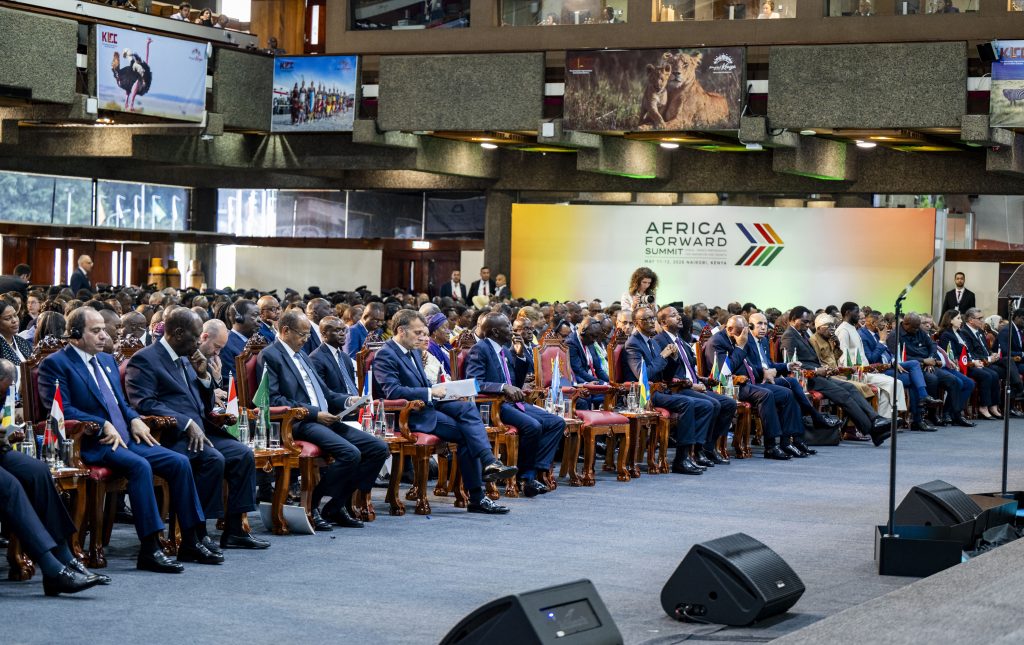
The Africa Forward Summit claims to mark a new era of partnership. But is anything really changing, or is “partnership” simply the new label for old dependencies? For decades, Africa’s development story has been framed around aid. That narrative evolved into “trade, not aid,” and later into “aid for trade.” Today, it is seemingly being repackaged as “new partnerships.” Behind this shifting language, the core dynamics remain the same: high-level discussions, carefully worded declarations, curated photo opportunities, and performative accountability. In these familiar templates, old dependencies are not dismantled. Instead, they are subtly preserved, repackaged, and reproduced through new frameworks.
Although the summit’s agenda introduces emerging themes such as AI and digital technologies, these additions do not fundamentally alter the template. Much like longstanding pillars such as peace and security, they are absorbed into a familiar policy script; one that repackages existing ideas rather than reimagining them. Thus, the declaration reiterates old commitments, with little evidence of a shift capable of breaking Africa out of entrenched dependency cycles.
“African-Led Solutions” Rhetoric and Its Contradictions
The first point in the final declaration is dedicated to “Strengthening Peace, Security and Strategic Autonomy.” This language is far from new in Africa–France summit diplomacy. The familiar rhetoric of “friendship” and “shared history,” among others, has been used and overused in multiple Africa–France summit diplomacy from Elysée in 2013 to Bamako in 2017 without producing any fundamental shift in France’s foreign policy in the region, particularly toward its former colonies in the Sahel.
Furthermore, analysts have long pointed out the contradiction at the heart of the “African-led solutions” rhetoric. The fact that it is consistently paired with continued reliance on external financing and coordination. This tension is not new but reflects a broader structural pattern in Africa’s security architecture, whereby external funding arrangements often constrain autonomy and shift decision making power beyond the continent. Perhaps, unless African leaders themselves dismantle these structures by financing security operations from within, the notion of “partnership” will remain largely rhetorical.
In terms of development financing as a whole, the declaration references Official Development Assistance (ODA) in its joint statement on renewed international partnerships and “solidarity with Africa”, a framing that, itself, reflects familiar development narratives. Under its commitment to “unlocking more capital for Africa,” the declaration explicitly recognizes that ODA must be complemented by broader forms of financing, while reaffirming the continued importance of concessional finance and the growing role of private capital and expanded financial flows. While this signals an awareness of the limits of traditional aid as seen recently, it does not amount to a departure from externally anchored financing models.
New Partnerships Under Old Monetary Dependency
The Africa Forward Summit declaration repeatedly frames the relationship between Africa and France in the language of “mutual benefit,” “co-investment,” “shared value,” and so on, suggesting that new partnerships will be on a level playing field. This framing, however, obscures the structural realities captured in what analysts describe as the Françafrique conundrum. Although President Macron has publicly declared that this era is “well over,” deep mistrust persists – particularly in the Sahel.
This tension becomes even more evident where the declaration calls for mobilizing a broad spectrum of financing. This ambition must be situated within the structural realities of existing Africa – France financial systems. Most former French colonies in Africa are still reliant on monetary frameworks like the CFA franc system tied to the French Treasury. Recent analysis points to the fact that the French controlled CFA system has serious implications for Africa’s development plan. This is primarily because, although France guarantees convertibility of the CFA franc, it also exercises considerable influence over monetary policy, including the long-standing requirement that a substantial portion of member states’ foreign exchange reserves be held in the French Treasury.
Other initiatives like the African Continental Free Trade Area (AfCFTA), which the declaration promotes as a driver of continental integration and industrialization, have also been affected by the CFA franc system as well. Therefore, without confronting these structural constraints, the narrative of “unlocking capital” risks reinforcing hybrid dependency where old aid logics and new market forces reproduce the same asymmetries.
Extractive Systems Continuity or “Made in Africa” Industrialization?
Historically, when African states gained “independence” in the 1960s, Charles de Gaulle ensured that new political elites safeguarded the continuity of French interests through informal networks, bilateral agreements, and enduring economic ties. France’s engagement with Africa has long been tied to securing raw materials and strategic markets. Many of the institutional, financial, and political structures established to sustain this model remain deeply embedded today, making transformative change toward genuinely independent economic relations uncertain.
Additionally, the scale and structure of French economic engagement in Africa, particularly through resource extraction, corporate networks, and financial linkages, often outweigh the impact of aid flows. In this sense, aid, however rebranded, remains marginal relative to the broader political economy of extraction and investment in Africa. French corporate presence across Africa is both deep and expansive.
Companies such as Bolloré, Castel, CFAO, Orange, Orano, Bouygues, TotalEnergies, and Alstom operate extensively across dozens of African countries, often dominating key sectors and shaping production systems. The activities of these corporations are structured in ways that confine local economies to low-value roles, crowd out infant industries, and limit domestic value addition. As a result, the notion of “Made in Africa” remains more rhetorical than real.
Moreover, while some of these French companies dominate key sectors across African economies, there are few (if any) African corporations exercising comparable influence within the French market. This imbalance in ownership, market control, and value creation reflects a deeply unequal Africa-France relationship. In such a context, the idea of equal partnership appears more rhetorical than real.
In conclusion, the Africa Forward Summit discussions and declarations on their own are unlikely to transform the underlying dynamics of France’s relationship with Africa. The structural conditions that sustain dependency and asymmetrical power relations remain firmly in place, ensuring that reliance on external support, often framed as “aid,” persists.