

Subscribe to the CIPS Newsletter
- Home
- Defining Antisemitism
Defining Antisemitism
 Full text (pdf)
By Peter Jones
CIPS Policy Brief, June 2026
At a glance…
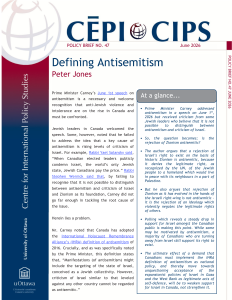
- Prime Minister Carney addressed antisemitism in a speech on June 1st, 2026 but received criticism from some Jewish leaders who believe that it is not possible to distinguish between antisemitism and criticism of Israel.
- So, the question becomes; is the rejection of Zionism antisemitic?
- The author argues that a rejection of Israel’s right to exist on the basis of historic Zionism is antisemitic, because it denies the legitimate right, as recognized by the UN, of the Jewish people to a homeland which would live in peace with its neighbours in a part of Palestine.
- But he also argues that rejection of Zionism as it has evolved in the hands of the Israeli right-wing is not antisemitic – it is the rejection of an ideology which violently negates the legitimate rights of others.
- Polling which reveals a steady drop in support for Israel amongst the Canadian public is making this point. While some may be motivated by antisemitism, a majority of Canadians who are turning away from Israel still support its right to exist.
- The ultimate effect of a demand that Canadians must implement the IHRA definition of antisemitism as national policy, and thereby move towards unquestioning acceptance of the expansionist policies of Israel in Gaza and the West Bank as legitimate acts of self-defence, will be to weaken support for Israel in Canada, not strengthen it.
 Peter Jones is a Full Professor at the Graduate School of Public and International Affairs at the University of Ottawa, as well as the Executive Director of Ottawa Dialogue. He holds a Ph.D. in War Studies from Kings’ College, London, and an MA in War Studies from the Royal Military College of Canada. Before joining the University of Ottawa, he served as a senior analyst for the Security and Intelligence Secretariat of the Privy Council of Canada for 7 years and also with Canada’s Department of Foreign Affairs for 7 years. He also led the Middle East Security and Arms Control Project at the Stockholm International Peace Research Institute (SIPRI) in Sweden in the 1990s. Peter leads problem-solving dialogues around the world and has published what is widely regarded as the standard text in the field, and also publishes regularly in leading journals in the field.