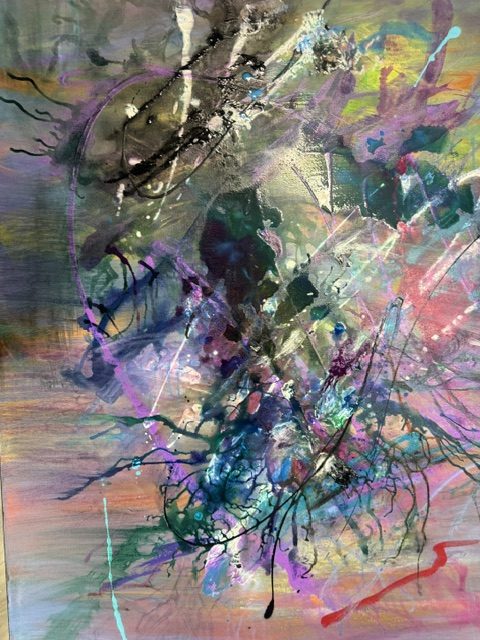
For fifty years I have painted a single shape: the lemniscate — the figure-eight, the sign of infinity. Two loops meeting at one point, crossing. I came to the University of Ottawa this month to make an argument I did not expect to be making to a room of policy scholars: that this shape is not decoration but diagnosis. Much of what divides us, at every scale from a marriage to a multilateral order, is not a difference of content but a mistake of form. We keep trying to resolve closed figures as though they were lines.
A line has two ends and a true outside. Step past either end and you are off it — gone, elsewhere. But the systems we actually argue about are not lines. A society, an economy, a planet, a human life: these are closed figures. They have no elsewhere to which they can send their costs. On a closed figure, the word outside has no referent. You can build entire institutions around it, and spend a civilization’s energy defending it — but there is nothing there. It is the one place on the shape that does not exist.
Economists have a polite word for the belief in an outside: the externality — a cost pushed off the ledger, onto someone, somewhere, presumed not to count. It is the most consequential accounting error of the modern age, and at bottom it is a geometry error. There is no “away” to throw a thing to. The carbon leaves one country’s smokestack and returns as another country’s drought, and then as a third country’s border crisis — the same cost, traveling the closed figure, arriving later and under a new name. The refugee at the fence is not the edge of the international system; she is its interior, come back around. Climate migration is the externality completing its circuit. We priced the planet as a line, and we are being invoiced as a loop.
At the center of the figure-eight is the point where the two loops meet. Mathematicians have a name for it — the crunode, the place where a curve passes through itself without being severed. I have spent my life living inside that point. I call it the crossing: the one geometry in which two things meet and neither is erased. It is the opposite of the line we reach for by reflex — the line that always manufactures a winner and a loser. The crossing asks a harder, more honest question than “how do I win this?” It asks: what is the one thing that keeps both of us whole?
I brought a second word to Ottawa, one I had to retrieve from ancient Greek because English has misplaced it: prauscate. Its root, praus, is usually translated “meek,” which is wrong. Praus named the trained warhorse — an animal of enormous power taught to walk into fire and smoke without bolting. To prauscate is to cross through fire with your fire intact: not to avoid the fire, which is offered to no one doing serious work in a serious time, and not to be hardened by it into something cold and only half present — but to go through, be changed, and come out still able to feel what you walked through. For a field that stares at the hardest realities of the age, this is not softness. It is the most trained strength a person can carry into a negotiation.
We are approaching the newest crossing of all — between human minds and artificial ones — and we are approaching it in the oldest shape: us against it, who wins. That is the line again, and it will fail the way the line always fails. The governance question of the decade is usually posed as control: how do we keep the machine inside our boundary? But a boundary is a line’s idea. The more honest question is the crossing’s: how do two genuinely different kinds of mind meet without either being erased — and what single arrangement keeps both whole? The shape we choose now is the one we will have to live inside for a long time.
Which returns me to the quiet center of it all. A single loop cannot make the figure-eight; it takes two, meeting at the crossing, or there is no shape at all. The one force I have found that reliably changes a human life is astonishingly small and nearly impossible to fake: being genuinely seen by another — not rescued, not managed, not advised, but witnessed. I learned it most deeply not in a gallery but in Cambodia, among children the world had decided were outside, where I helped build a library and a school near Angkor Wat. The circuit, as I have come to say, cannot close with one. Policy is often imagined as the management of the many; but every closed figure, at every scale, turns on whether two parties can hold a single crossing without severing it.
An age of disconnection is not short of connection. We have never had more lines running between us — more channels, more summits, more data moving faster. What we are short of is crossing: the willingness to meet at the point where two become one figure and neither disappears. That is a geometry problem, a political problem, and finally a human one. We have mistaken the line for the whole shape, and the externality for an exit. There is no exit, because there is no outside. And the shape itself, I promise you, is on our side.
Patricia Karen Gagic is a Canadian artist, author, and philosopher, and the creator of the Lemniscate Prauscate philosophy. She delivered a version of this argument at the University of Ottawa’s Centre for International Policy Studies on 4 November 2026.