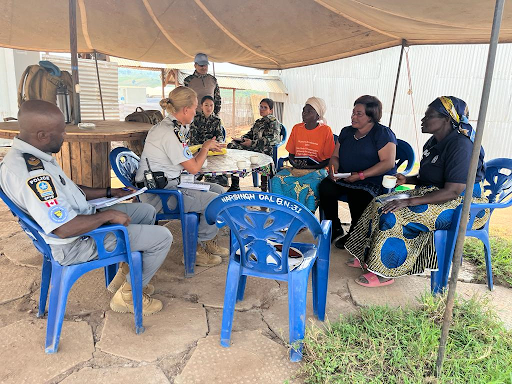
On March 30, 2026, the Gender, Peace and Development Research Network at the University of Ottawa’s Centre for International Policy Studies hosted a screening of A War Movie (Casques bleuEs), a cinéma vérité documentary that follows Canadian women peacekeepers deployed as part of the United Nations Specialized Police Team to combat sexual violence in the Democratic Republic of the Congo.
As the Director of the International Peace Operations Program at the Royal Canadian Mounted Police (RCMP), I was honoured to attend the event and participate in the “Question and Answer” segment afterwards.
Over the course of my work in international peace operations, I’ve seen firsthand how policing can serve as a bridge between security and trust. In fragile and conflict-affected environments, the presence of legitimate, accountable policing institutions is often one of the clearest indicators of whether a state is moving toward stability. Supporting police and building their capacity to maintain the rule of law can help prevent transnational criminal activities, and serious and organized crime from spilling across borders into other countries, including Canada.
Canadian police officers contribute to that effort not by imposing solutions, but by working alongside local counterparts, sharing experience, building capacity, and supporting reforms that reflect the communities they serve. What makes Canada’s approach stand out is how we come together as a policing community.
Police officers from municipal, provincial, Indigenous, territorial, and federal services deploy under a common framework known as the Canadian Police Arrangement, bringing a wide range of perspectives and expertise to each deployment. That diversity is one of our strengths. It allows us to adapt to complex environments and offer practical, experience-based support, whether it’s in community policing, leadership development, or addressing issues like organized crime and gender-based violence.
As seen in the screening of A War Movie, deployed Canadian police officers play a critical role in implementing Canada’s National Action Plan on Women, Peace and Security. They contribute to the development of professional and effective law enforcement institutions that respect human rights, particularly those of women, girls and marginalised communities; protect civilians from violence, including sexual violence; and meet the needs of the local population. Increasing the meaningful participation of women in peace operations missions is both the right and smart thing to do.
Canada is a leader in the deployment of women police officers. Not all police contributing countries have women involved in front-line policing. Our professional, well-trained, and capable women police officers set an example and provide mentorship to police in the host nation. Further, it is sometimes the first time men from other police contributing countries have the benefit of working alongside women counterparts, giving them a broader perspective and new respect for the contributions of women police officers. For deployed women police officers, navigating this dynamic allows them to showcase their skills and abilities, and bridge the divide that exists within some policing communities.
We recognize the importance of ensuring that women work in all positions and capacities within peace operations, and, in particular, senior and leadership positions. We actively look to deploy Canadian women police officers to senior roles within missions. We also seek opportunities to train women police officers in foreign countries to participate in peace and stabilization missions.
Our deployments are not one-way contributions. They shape us as much as they shape the environments we work in. Deployed personnel return with a deeper understanding of cultural context, resilience, and the broader impact of policing in society. That experience strengthens our institutions at home and reinforces the values that underpin Canadian policing, professionalism, inclusion, and service.
Our partner police agencies who allow their personnel to deploy to peace operations missions have a unique opportunity to represent Canada on the international stage, and to provide developmental opportunities to their members. The communities they serve get back police officers with a more global perspective and an improved ability to engage with people from different cultures.
The Canadian policing community understands that a safer world means a safer Canada. Unstable societies offer opportunities for crime to flourish. By helping host-nation police to fight crime in their communities, our police officers help reduce the spread of crime to our own communities.
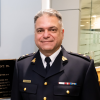
Superintendent Rabih Abdallah is the Director of International Peace Operations for the RCMP. He participated in the event “Women on the Frontlines: Gender, Conflict, and UN Peacekeeping in the DRC – Film Screening + Discussion” which took place on March 30, 2026.