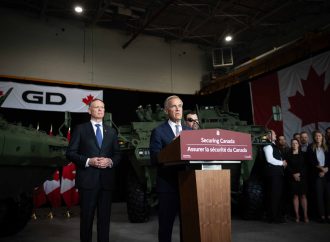
The Davos speech by Prime Minister Mark Carney was a watershed moment in the history of Canada. It was the public affirmation that the global order constructed over the post-war period, which facilitated US hegemony and benefited Canada, was being weaponized as a tool of domination and subordination. However, this was not news to many Africans. The continent has been the exporter of raw materials at the bottom of the international value chain. Commodity dependence has led to few jobs and has been subject to boom and bust cycles. Countries on the continent also find themselves at the bottom of the hierarchy of international currencies and hence must constantly earn, attract or borrow US dollars or other hard currencies to sustain their economies.
Since 2020, many Africans are again in a debt crisis and subject to the imposition of punishing austerity by the International Monetary Fund (IMF) and a framework for debt relief (G20 common framework) that has performed poorly and does not address underlying structural causes. The deteriorating situation is compounded by Trump’s abandoning of instruments of soft power and move towards coercion. African countries have been subjected to a roller coaster of tariffs along with massive aid cuts and a delayed and limited extension of the African Growth Opportunity Act. Trump’s overt expansionism, militarism, and growing belligerence toward historical allies is breaking down the US dominated old order creating new opportunities for the continent.
The US National Defense Strategy (NDS), released in January 2026, was aimed at creating “the world’s strongest and most lethal and most capable military”. On April 2, 2026, Secretary of War, Pete Hegseth, requested a massive increase of the defense budget to $1.5 T which if granted would push the US back above 40% of the global total (which had fallen to 33% in 2025).
One Achilles’ Heel of the US military that the Chinese are fully cognizant of is access to critical minerals. More than three quarters of US defense platforms use minerals under the control of Chinese supply or processing. On March 20, 2025 Trump issued an executive order aimed at urgently increasing mineral production. However, securing critical minerals has been very problematic as the Chinese continue to outmaneuver the US in securing access to new mines. In March 2026 it was reported that the US military had only two months’ worth of critical materials left in its defense stockpile after blowing through billions of dollars of munitions in support of the war against Iran, forcing Trump to invoke the Defense Production Act on June 11, 2026 to speed up production and create an “enduring capability.”
Despite the punishing patterns of aid curtailment (nearly 50% drop in 2025), the overt racist comments against Africa and Africans and associated unprecedented banning or effective banning of visas and immigration from the continent, the Trump administration has come to the realization that Africa has 30% of the world’s minerals that are vital to the US military.
An opportunity for a new African strategy focusing on accessing critical minerals arose out of the desperation of the Congolese government. On February 8, 2025, Congolese President Tshisekedi offered the US government access to critical minerals in exchange for a formal security pact and military help to defeat the M23 rebel group. This set in motion a series of events leading to the June 2025 “Minerals for Peace” accord between Rwanda (backers of M23) and Congo in return for access to Congolese resources.
In December 2025, Congo (DRC) and the US signed a 30 page strategic partnership agreement which aims to “Facilitate stable, predictable, long-term access for U.S. persons and aligned persons to critical minerals from the Democratic Republic of the Congo to support safety, security, and prosperity for both the United States of America and the Democratic Republic of the Congo…”.
A Congolese list of strategic asset reserve (SAR) projects available to US companies was to be established for US investments overseen by a Joint Steering Committee between the two countries. Focus was on the Lobito corridor as the “key route for the transport and export of copper, cobalt, zinc, and other critical minerals…from the Democratic Republic of the Congo to the United States of America.” The plan was to create strategic mineral reserves “to ensure predictable and durable supply of critical minerals including cobalt for the United States.”
A key vision of the accord was to “Strengthen opportunities for cooperation in security, defense, and protection of critical infrastructure, in safeguarding the integrity of the Democratic Republic of the Congo’s territory and strategic mineral reserves”. On April 27, 2026 the US, along with the United Arab Emirates (UAE), agreed to finance a $100 million paramilitary force of 20,000 to protect mining sites, foreign investments and mineral shipments. This follows the murky arrival of the close Trump associate Erik Prince and Blackwater who received a $700 million contract with the DRC in 2025 to secure minerals and mineral revenues.
The first meeting of the joint steering committee occurred in February 2026 generating the initial list of SARs available for US investments. The same month, Orion Critical Minerals Consortium (OCMC) signed a Memorandum of Understanding (MOU) to purchase a 40% stake in the Swiss mining company Glencore which produces copper and cobalt in the DRC. OCMC was created in October 2025 by the private investment firm Orion Resource partners, Abu Dhabi’s ADQ, their sovereign wealth fund which in 2021 invested heavily in Jared Kushner’s private equity firm, and the US International Development Finance Corporation, the private sector focused arm of the US government that partly replaced the United States Agency for International Development (USAID). Here we have the murky world which fuses Trump’s personal connections with state subsidization of private accumulation which benefits from military priorities.
The Lobito rail was originally constructed by the Portuguese in 1902 for the colonial extraction of minerals from the copper belts of Northern Rhodesia and the Belgian Congo. Trump is clearly following the same colonial style pattern of securing and extracting mineral resources.
The African continent sits at a crucial juncture. Critical minerals are central to the transition away from fossil fuels. They can become the building blocks for a continent based value chain of green manufacturing and energy allowing the continent to finally generate its long delayed structural transformation. They are also critical for the armies of the 21st century and needed for Trump’s military aspirations. To fulfill the former, African countries will need to push back against the bilateralism which is crucial to Trump’s coercive strategy and build a multilateral coalition, hopefully in cooperation with the other members of the Global South and middle powers in the North like Canada that are threatened by growing American belligerence.
Howard Stein is a Professor in the Department of Afroamerican and African Studies and Department of Epidemiology at the University of Michigan; a Visiting Fellow at the Balsillie School of International Affairs; and a Visiting Researcher at the School of Environment, Resources and Sustainability at the University of Waterloo. On May 13, 2026, he spoke at a CIPS event titled “Trump, Africa and the Multipolar Interconnected World: The Role of Trade and Financial Flows“.