On July 4, 2026, the United States celebrated the 250th anniversary of its Declaration of Independence from Great Britain.
For Americans, this is a moment to reflect on what their country has accomplished, from the amazing (e.g., the airplane, the moon landing, semiconductors) to the horrible (e.g., slavery, Jim Crow laws, Hiroshima and Nagasaki, ICE). They have much to celebrate but also a lot to reflect on.
For Canadians, it is also a moment that we should celebrate, not just with our American friends but for ourselves! For 250 years, we have remained independent from the United States. Their history is also ours.
Just a few weeks before the Declaration of Independence, American troops (known then as the Continental Army) left the Province of Quebec after their ultimate defeat at Quebec City’s ramparts – after many months of laying siege to the city – and the reclaiming of Trois-Rivières and Montreal by freshly arrived British troops. The “Americans” had failed to conquer “Canada”. (You can read all about it in Madelaine Drohan’s excellent book, He Did Not Conquer.)
Were it not for this defeat, there would be no Canada today. We would be the 51st state of the United States of America. More precisely, we would have been the 14th state. The name Canada would have been long forgotten.
The threat of annexation by the U.S. is, in large part, what has made us, Canadians, who we are. Canada’s foundation as a country in 1867 was a response to this threat. We celebrate July 1st as Canada Day, but we should also celebrate July 4th as our own Independence Day.
250 years later, Canada, as a land and its peoples, still faces this “annexation” reality. A majority of Canadians certainly feel that the U.S. is, again, a threat to Canada’s sovereignty.
President Trump still talks (or posts on Truth Social) about Canada as the 51st state, a year and a half after being back in the White House. For Trump, his acolytes and many Americans (not to mention a not insignificant number of Canadians), Canada becoming the 51st U.S. state makes perfect sense.
From their perspective, if Canada were part of the U.S., it would gain complete free trade with its largest economic partner, a more productive economy and full access to the best military in the world, not to mention lower taxes! Moreover, our pensioners could live in Florida or Arizona full-time. What’s not to like? And, for those who believe that Canada is broken, joining the U.S. is an attractive solution.
That’s why I told the audience at the recent “AmbCanada–CIPS Conference: Realities and Illusions of Canadian Foreign Policy” that Canada’s reality is the 51st-state challenge.
Specifically, I said that, from a purely rational, economic perspective, it would make sense for Canada to join the U.S.
Thankfully, at least as far as I am concerned, a majority of Canadians value Canada’s economic independence from the U.S. and are willing to pay an economic price for it.
According to the Economic Patriotism Index, built from a survey of 1,301 adults living in Canada in August 2025, 75% of respondents had a moderate (41%) or high (34%) level of economic patriotism. The index “measures Canadians’ willingness to sacrifice in terms of prosperity and well-being for economic independence”.
Surprisingly, perhaps, 47% of the survey’s respondents who intended to vote for the Conservative Party of Canada (CPC) had a low level of economic patriotism, compared to 8% for those supporting the Liberals, 13% for Bloc Québécois voters and 6% for NDP supporters. This would also explain why the highest percentage of Canadians supporting Canada becoming the 51st state is, by far, found among CPC voters (21% according to a March 2025 poll).
At the conference, I also argued that it is an illusion to think that our political independence can withstand continued economic and security integration with the United States. Greater integration gives the United States more leverage over Canada’s economy and security, which the Trump administration has been only too happy to exercise.
That is why a so-called “Grand Bargain” (or the more recent “Fortress North America”) is so risky for Canada’s sovereignty; it would bring us closer to a de facto 51st state.
The grand bargain is not a new idea. It was also put on the table of options after the 9/11 terrorist attacks in 2001, when the U.S. started “thickening” the border to increase their security, with negative consequences for the Canadian economy. In the end, there was no grand bargain, only the Security and Prosperity Partnership of North America, which had limited success and was abandoned in 2009.
The grand bargain idea is based not only on the above-mentioned illusion of political independence despite further integration but on another illusion: it is impossible to significantly reduce Canada’s economic dependence on the U.S. because of its gravitational pull. In other words, we have no choice but to integrate our economy with our southern neighbour’s, as much as possible, if we want Canada’s economy to thrive.
As I argue here, it is possible, if not easy or cheap, for Canada to reduce its dependence on the U.S. and maintain its sovereignty over its economy and security: Canada needs a moonshot to its Sputnik moment (i.e. Trump’s “return with a vengeance” to the White House). It’s the only way to put Canada on a higher (i.e. freer) orbit to the United States’ gravity, which doesn’t mean that Canadians have to stop doing business with Americans.
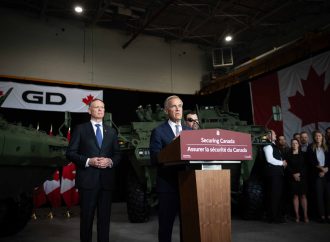
Notwithstanding Prime Minister Carney’s puzzling support for Fortress North America at a recent conference in New York City, the moonshot is exactly what he and his government seem to be going for. Budget 2025 called for one trillion dollars in investment over five years (half of it to come from the private sector) to make “Canada Strong”. So far, a majority of Canadians support Carney and his government’s efforts.
250 years ago, Americans tried to convince the (mostly French-speaking) Canadians living in the Province of Quebec to join their independence movement against Great Britain, arguing that they would be better off economically.
According to Drohan’s He Did Not Conquer, most Canadians refused to join in the rebellion. Not only did they doubt the economic gains that would come if they joined the 13 American colonies in their independence fight, but they also feared the loss of their language, religion and civil laws (i.e., their identity).
For 250 years, Canadians have wrestled with the same “51st-state” challenge. It has ebbed and flowed over time, but it has never disappeared. It is part of our country’s fabric. What is clear is that Canada has always been much more than an economic concept for Canadians. That’s something worth celebrating and shooting for the moon!