In the end, Canada and the United States didn’t get a trade deal. Ultimately, it doesn’t matter.
Yes, a deal would have prevented further economic woes imposed on Canada in the short run. But what matters is that the Carney government didn’t give in to the Trump administration’s economic coercion.
Concessions were made during the negotiations but not to the point of increasing our long-term dependence on the U.S. or confirming to the Americans that they can threaten us successfully. That was the right move. Otherwise, the Americans would soon be back for more.
The best way to understand trade negotiations between Canada and the U.S. is by viewing them as a game of chicken.
Such a game is best understood as two cars running toward each other at full speed. Whichever driver loses their nerve and swerves first to avoid a head-on collision loses the game. Of course, if nobody swerves, both drivers are hurt, but they retain their reputation.
So, in the case of Canada-U.S. trade negotiations, it is Prime Minister Mark Carney and President Donald Trump speeding toward each other.
For the July 1 renewal deadline of the United States-Mexico-Canada Agreement (USMCA), Canada didn’t swerve, despite the implicit threat that the U.S. could quit the USMCA if Canada didn’t concede to U.S. demands. After all, Mr. Trump had begun calling it a bad deal for the U.S., even though he said back in 2018 that it was the best deal ever.
In the end, it was the Trump administration that swerved. Nothing happened on July 1. U.S. Trade Representative Jamieson Greer, who is responsible for negotiating trade deals for Mr. Trump, said the U.S. and Canada would just continue negotiating. To use the expression coined by Financial Times journalist Robert Armstrong, it was another case of TACO (“Trump Always Chickens Out”).
Then, on July 20, the White House issued a new threat: 50-per-cent tariffs on more than US$20-billion worth of imports from Canada, as per Section 338 of the Tariff Act of 1930. Mr. Trump gave Canada one month to make a deal to avoid the tariffs.
For the Carney government, the best strategy going into these new negotiations (for a smaller, temporary deal rather than the whole USMCA) was to keep going full steam ahead and show that it was ready to throw away the steering wheel. In the game of chicken, doing so signals to your opponent that you can’t swerve and are willing to crash. It shows how serious you are about holding course and not conceding.
That’s exactly what Mr. Carney and his team did. They indicated that they were ready to walk away from a deal and face the threatened tariffs. We are told that the U.S. made last-minute demands, still thinking that Canada would swerve in the end.
A deal where Canada is giving up relatively little (e.g., putting U.S. booze back on the shelves) in exchange for no Section 338 tariffs and lower levels of existing U.S. tariffs on aluminum and steel products, for example, was the only deal that the Carney government could sell to Canadians.
Otherwise, it was better to continue agreeing to disagree with the Trump administration and suffer the consequences, which, according to opinion polls, Canadians are willing to do. They don’t want to give in to bullying.
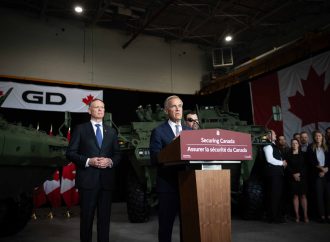
If the Carney government had offered more concessions – guaranteed purchases of military equipment and systems, or unfettered access to Canada’s digital markets for U.S. Big Tech, including for government contracts (now excluded in the USMCA), which would make Canada more dependent on the U.S. – then Canadians would have seen such a deal as “elbows down” and caving to Mr. Trump’s coercion.
Even if such a deal provided economic relief, it would have been only temporary. Canadians know that if Mr. Trump’s coercive tactics had proven to work on Ottawa, he would have come back asking for more “flesh” in no time.
In the end, deal or no deal, what matters is the long game. What matters is that Canada’s economic and security dependence on the U.S. continues to decrease, thereby giving Canada even more leverage vis-a-vis the U.S. in future trade negotiations.
Free trade in North America may be dead, but Canada is now freer to pursue its own economic path.
This article was first published in The Globe and Mail on August 22, 2026.