Conflict-related sexual violence (CRSV) is often dismissed as an unavoidable by-product of armed conflict and relegated to the margins of legal, political, and historical discourse by pervasive stigma and institutional impunity. International policies such as United Nations (UN) Security Council Resolution (UNSCR) 1325 and subsequent UNSCRs on women, peace, and security (WPS) have been central to changing political discourse and action. UNSCR 1820, for example, explicitly defines sexual violence as a deliberate weapon of war which has fundamentally transformed how CRSV is understood, documented, and prosecuted. Resolutions UNSCR 1888 and 1960 created dedicated institutional mechanisms to prevent silence and erasure such as the Office of the Special Representative of the Secretary-General on Sexual Violence in Conflict (OSRSG-SVC), the deployment of Women Protection Advisers in peacekeeping missions, and formal monitoring, analysis, and reporting arrangements (MARA) that track perpetrators and publicly name offending parties in annual UN reports.
Peacekeepers, survivors, human rights defenders, and filmmakers are transforming how the world documents and confronts CRSV. Preserving survivor testimonies is no longer a passive act of record-keeping. It is a vital tool for justice and healing, and a crucial strategy against the growing threat of historical and digital erasure.
Bearing Witness Through Film: The Story of Traces
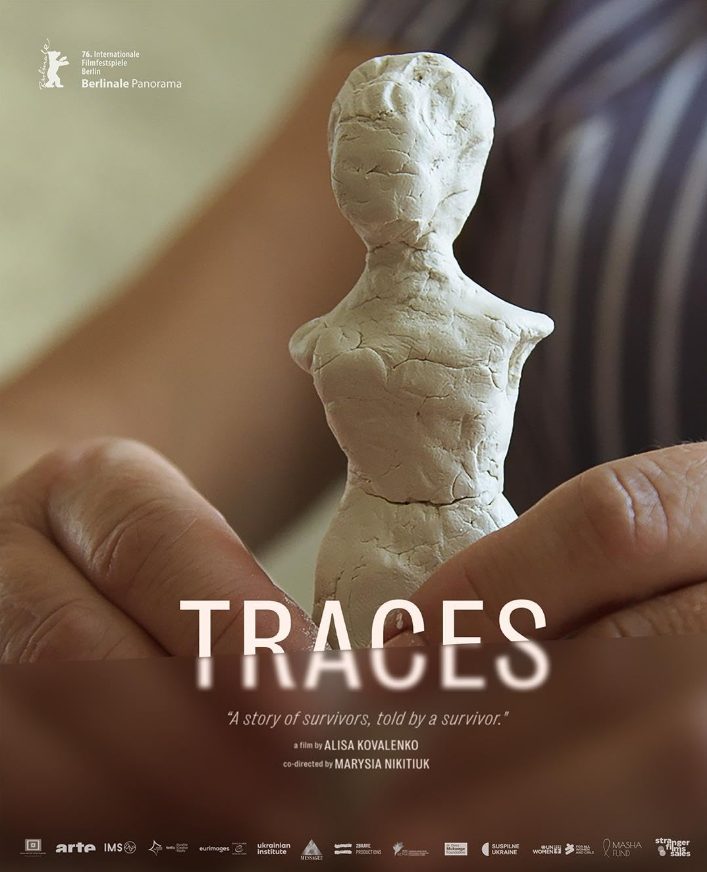
A powerful example of this survivor-centered preservation is the 2026 documentary Traces, directed by Alisa Kovalenko and co-directed by Marysia Nikitiuk. Although Alisa Kovalenko does not appear on screen, her work was deeply inspired by her experience as the first woman to document CRSV in Ukraine in 2016. On November 3, 2026, the Gender, Peace and Development Research Network of the Centre for International Policy Studies at the University of Ottawa, the Ukrainian Women’s Fund and the Research Network on Women, Peace and Security hosted a screening of the film followed by a Q&A session with Alisa Kovalenko, highlighting its urgent message of ending stigma and countering the erasure of WPS narratives.
Traces weaves together the testimonies of six Ukrainian women from Donbas, Kherson, and Kyiv who survived sexual violence and torture during Russia’s aggression. Rather than sensationalizing their pain, the film highlights women’s voices and agency against the backdrop of nature, gardens, and changing seasons. This visual poetry ensures the respect and dignity owed to each survivor while contrasting sharply with the devastation of war. Unsettling images of a burning tree, fields of dead plants, and branches trapped in ice remind viewers of dark moments before giving way to spring. The film’s profound metaphors for resilience, solidarity, and the persistence of beauty amidst destruction underscore how the survivors turn shared trauma into a collective force for truth, accountability, and hope.
At the center of the documentary is Iryna Dovhan, a prominent Ukrainian human rights activist and head of SEMA Ukraine (the Global Network of Victims and Survivors to End Wartime Sexual Violence). In 2014, Iryna Dovhan was abducted, publicly humiliated, and tortured by Russian-backed militants in Donetsk for supporting the Ukrainian army. She feared her perpetrators would never face justice and that her suffering would fade into obscurity as the world moved on. Speaking on the significance of the documentary, Iryna Dovhan reflected:
“This film gave me hope that memory will not disappear, that our testimonies are now permanently recorded. That I am no longer alone in the world in my fight against evil—that memory will not fade, that our testimonies have been preserved forever.”
For survivors, cinematic and archival preservation becomes an essential weapon against fading memory, validating their experiences and building collective solidarity.
Breaking Impunity and Reclaiming Agency
Historically, perpetrators of wartime sexual violence operated with near-total impunity because crimes vanished into the fog of war. When survivor accounts are recorded under rigorous ethical standards, personal tragedies become actionable legal evidence. In landmark cases before the International Criminal Tribunals for the former Yugoslavia (ICTY) and Rwanda (ICTR), preserved testimonies established that rape and sexual violence constitute war crimes, crimes against humanity, and instruments of genocide. Today, initiatives like the Murad Code Project and the International Criminal Court (ICC) rely on survivor-centered documentation to pursue accountability, ensuring the statute of limitations on truth never expires.
Beyond legal justice, ethical documentation helps survivors reclaim control over their narratives. War strips individuals of autonomy, and societal stigma often shifts shame onto the victim. Trauma-informed documentation flips this dynamic by allowing survivors to choose what to share and how their words are used. Furthermore, analyzing patterns across preserved testimonies provides policymakers and humanitarian agencies with the critical data needed to design holistic reparations, targeted healthcare, and mental health services for survivors and children born of war.
Possibilities and Perils of Survivors’ Documentation and Databases
While permanent records empower survivors, preserving information in the digital age faces complex new threats. In authoritarian regimes and active conflict zones, data is routinely weaponized. If a human rights database is hacked, subpoenaed, or seized, unredacted files can become a ‘hit list’. Consequently, defenders must navigate a delicate balance between safeguarding evidence and protecting lives through human rights data scrubbing: the intentional removal or alteration of sensitive personal indicators to prevent political persecution and physical harm.
Examples of protective human rights scrubbing in the case of Afghanistan following the 2021 Taliban takeover, show the urgent action taken to protect local women peacebuilders, female judges, and civil society leaders from having their personal and identifying information appear in official records. Governments like Canada and the United States scrubbed thousands of public articles, photos, and videos from official websites to prevent the Taliban from using facial recognition tools to identify collaborators. Meanwhile, organizations like Human Rights First distributed emergency guides in Dari and Pashto instructing Afghans on how to wipe phone metadata and delete social media histories.
However, data scrubbing is increasingly deployed—both intentionally and automatically—in ways that erase vital evidence rather than protect people. Authoritarian regimes actively censor records related to WPS to rewrite history. Simultaneously, major social media platforms rely on automated data scrubbing and AI content moderation to flag graphic or sexually explicit material. Because these algorithms lack contextual awareness, they frequently delete irreplaceable first-hand documentation uploaded by survivors and journalists. This automated erasure carries devastating legal consequences when it undercuts war crimes prosecutions at the ICC and international tribunals. Erasure of data also silences survivors and censors women who use digital spaces to bypass local systemic biases and break through social stigma. The failure to preserve digital data can also have impacts on asylum seekers claiming refugee status when they are no longer able to access the records documenting the human rights abuses they experienced.
Navigating these risks requires committing to the safe and secure collection of data and innovations such as encrypted repositories, decentralized backups, and forensic verification tools, such as the Berkeley Protocol on Digital Open Source Investigations, to ensure open-source evidence is captured securely before tech platforms or hostile actors can scrub it away.
Conclusion: Voices That Shape the Future
Preserving testimonies of sexual violence in conflict is an act of defiance against the forces that seek to silence, dehumanize, and erase the lived realities of survivors from the historical record. Whether through films like Traces or through secure digital archives, every recorded voice stands as a testament to human resilience. By safeguarding these truths against both political censorship and technological erasure, we honor the courage of survivors like Iryna Dovhan, hold perpetrators accountable, and protect the historical record. Ultimately, listening to and preserving these testimonies does more than illuminate the horrors of war: it ensures that survivors never fight alone and that their stories have their intended impacts.