The Independent Commission on Disarmament and Security Issues (ICDSI) in 1982 offered this to frame the idea of common security:
States can no longer seek security at each other’s expense; it can be attained only through cooperative undertakings. Security in the nuclear age means common security. Even ideological opponents and political rivals have a shared interest in survival. There must be partnership in the struggle against war itself.
To be clear, common security is not automatically a pacifist outlook, but it is unquestionably a less violent, less-threatening, and reduced-armaments project. However, you cannot do away with reliance on a flawed regime such as nuclear deterrence without replacing it with something that is better and less risky, while still retaining credible protective security mechanisms. Therefore, in cases where there are violations of UN Charter norms by bad actors acting badly, what are the enforcement tools that we are left with?
When outlining what common security is, we typically list the diplomatic, preventative, conflict resolution, confidence-building, disarmament, and sanctioning measures – everything we can think of, short of use of military force. And arms control to achieve only a stable military (including even nuclear) balance, can end up abandoning disarmament opportunities, and thereby unhelpfully legitimize certain weapon systems we should be rid of.
The “common” in common security is about reaching security arrangements primarily with real or potential adversaries, not only our continuing allies. While unrestrained deterrence can result in mutually threatening postures, common security by contrast is, in some ways, the embrace of mutual vulnerability. Being vulnerable may not sound like the hallmark of a comfortably secure future. But nuclear deterrence at its core, let’s remember, is fundamentally a doctrine of mutual vulnerability, except one based on reciprocal mass killing and even human extinction.
The Rule of Law Requires Enforcement
Hans Blix makes a very convincing argument in his book A Farewell to Wars. While there have been violations of UN Charter obligations towards non-use of force, overall the norms have been upheld or honoured even in the breach. Yes, there’s been erosion. Yet, whenever an intervention has taken place, it is typically followed by unconvincing ‘justifications’, and early rebukes from much of the global community for norm violations. Israel bombing Iraqi nuclear reactors and killing nuclear scientists in 1981, or the US and Israel bombing Iranian nuclear facilities in “anticipatory self-defence”, Russia’s invasion of Ukraine, what happened on October 7 in Israel, and since October 7 in Gaza and the West Bank… these actions were broadly condemned, although not by all. In other cases where atrocities have occurred, the global public mind has reacted in disgust, not in disinterest. Small comfort to the dead, but Blix insists inaction in the face of massacres is “unbearable.”
In other words, an international response framework for action is still desirable. That framework in the end is contingent upon an enforcement capability. The question is: who will provide it, and with what?
Defence
A primary reason why the world now burns through almost three trillion (US) dollars in military and defence spending is that 195 individual countries build up their militaries to deter adversaries rather than invest in less costly shared international security systems that they apparently don’t find sufficiently trustworthy, reliable or sustainable. A few outlier states build militaries to dominate others, but most do not. And yet the sensible lower cost approach is explicit in the UN Charter, Article 26, referring to “least diversion for armaments.”
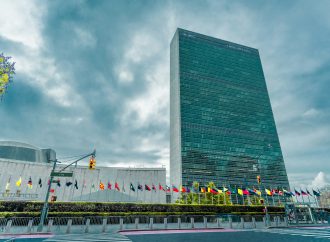
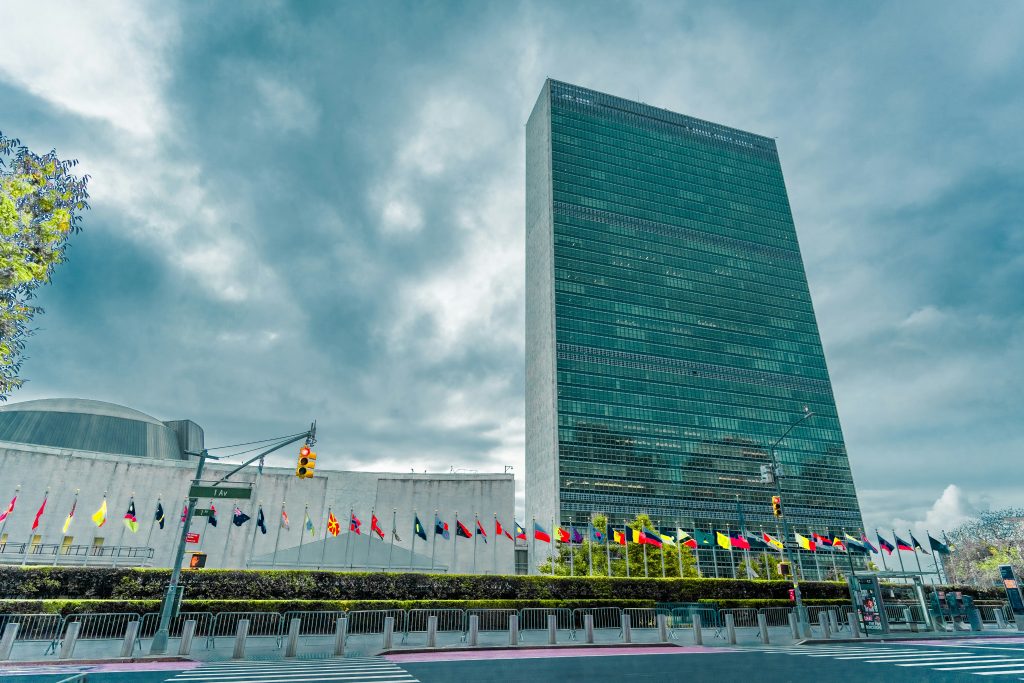
All UN members by default have signed onto both Article 42 (collective security) and Article 51 (self-defence and collective self-defence) as core benefits and obligations of the UN Charter. These are the fallback protection ‘guarantees’ that kick in, absent the successful prevention of conflict.
The 1982 Palme Report: Common Security, a Blueprint for Survival is fundamentally framed around principles of cooperation, and of disarmament, and non-use of force to the extent possible. But it is also very clear that the UN Security Council remains the authority when conflict does break out. While there should be peacekeeping capability, enforcement will rely on collective security processes, and here, the Blueprint states, the UN Security Council would provide “appropriate UN military force at the request of one of the disputing states” — ideally to prevent conflict — and thereby provide “a visible deterrent to a potential aggressor.”
Note the word: “deterrent.” Where deterrence fails and violation of territory does take place, “limited enforcement measures would become necessary”, initially to establish a negotiated ceasefire. “Full-scale collective security enforcement action”, the Palme Report states, would re-establish the status quo through military means. “This is the ultimate deterrent enshrined in Chapter VII of the UN Charter” and this must remain “a goal towards which the international community works.”
The Report goes on to support UN peacekeeping and members’ standby forces also as “a deterrent to aggression or to establish a ceasefire.” A further enhancement of early response capabilities, however, can be found in the proposed UN Emergency Peace Service (UNEPS) which would be a multipurposed standing service made up of soldiers, police and civilians, hired, trained and maintained directly by the UN. The advantage of having UN employees is multifold, but a key advantage is that narrow allegiances that might be retained by seconded national standby forces (the current model for peacekeepers) could be severed.
In summary, then: Common security is a credible replacement for nuclear deterrence and fraught competitive security arrangements. It offers a range of non-provocative defence postures to deter war, and encourages arms control and disarmament, diplomacy and conflict resolution. It also relies on the framework of international law, including the deterrent and enforcement capabilities spelled out in the Articles of the United Nations Charter.
Robin Collins has advocated in support of disarmament, common security, and alternative defence for over 30 years. From 1996-2002 he was a board member and later Chair of Mines Action Canada, and primary author of MAC’s 2001 position paper on cluster bombs. He is a past co-chair of the Canadian Network to Abolish Nuclear Weapons. He is current Secretary of Canadian Pugwash Group and is on the board of the Rideau Institute (RI). Collins worked with the Group of 78 and RI to draft an alternative security policy, The Shift to Sustainable Peace and Common Security (which will be updated in 2026).
He recently spoke at the CPG/CIPS Conference held on October 2nd, titled “Canada and the Middle Power Challenge“.